 Business License

UV Curing in Medical Device Assembly: Cured Is Not the Same as Validated
Medical Devices Change What Curing Has to Prove
In most industrial assembly, a cured bond passes when it holds the part together. In medical device manufacturing, that is the smallest part of the requirement. The bond must survive sterilization, contact with tissue or body fluids, a service life defined in the risk file, and an audit trail that follows the part from raw material to finished device. A curing process that cannot demonstrate all four is not a qualified process, whatever the visual inspection says.
Ultraviolet curing, delivered through a UV LED curing lamp, is widely used in device assembly because it sets in seconds, needs no oven, leaves no solvent residue in the conventional sense, and bonds a wide range of plastics, glass, and metals. Those advantages are real. They are also why the technology is sometimes introduced onto a device line before the validation work is understood, and why the problems that follow are framed as equipment problems rather than as process gaps.
This article is written for the process engineers, quality leads, design engineers, and contract manufacturers who assemble medical devices and have to justify a UV step in an audit file. It covers where UV bonding and curing appear in device production, what regulatory and biocompatibility expectations attach to the cured film, how cure completeness is proven rather than assumed, and what the equipment and process controls look like on a line that has to defend its records.
The Regulatory Frame: What "Validated" Actually Means
Medical device production operates under design control and quality management expectations that differ from general industrial manufacturing. A curing step is part of the device's manufacturing process, and the process must be validated against the requirements that apply to that device's classification and risk.
For a contact device, the cured adhesive film is a material in contact with the patient, at least indirectly. Biocompatibility evaluation under the applicable ISO 10993 family considers the finished material in its finished, cured state, not the uncured adhesive in its cartridge. That distinction matters: an adhesive that is listed as medical-grade does not automatically make a partially cured film biocompatible, because residual monomers, oligomers, and photoinitiators are precisely the species the evaluation looks for.
Sterilization compatibility is a second layer. The cured bond must survive whatever process the device goes through — ethylene oxide, autoclave, gamma or electron-beam irradiation, or chemical disinfection — without delaminating, crazing, or releasing species that the sterilization process then redistributes. A bond cured for room-temperature handling but not for the sterilization cycle is an incomplete qualification.
Traceability is the third layer. The batch of adhesive, the cure settings, the dose delivered, the operator, and the acceptance result are recorded against the device lot. In a recall investigation, those records determine whether a cure process is defensible, and an undocumented recipe is the most common gap found in audits of UV steps.
Where UV Curing Appears in Device Assembly
Ultraviolet steps appear across several distinct assembly tasks, and the requirements differ by task even when the adhesive looks similar.
Catheter and tubing assembly. Tubing to hubs, strain reliefs, and marker bands are bonded with UV adhesives that must flex with the catheter, resist body fluids, and survive EtO sterilization. Shadowing at the tubing-to-hub interface is a recurring challenge, and bond-line thickness is constrained by the catheter's outer diameter.
Sensor and module bonding. Diagnostic devices, infusion pumps, and monitoring modules contain sensors, lenses, and windows bonded to housings. Here the requirement is positional stability: the bond must not shift the optic or sensor during cure, and the cured film must not outgas onto an optical surface.
Enclosure and gasket bonding. Housing halves, frames, and elastomeric gaskets are bonded or sealed where a flexible, gap-filling joint is needed. These joints often meet dissimilar materials and must accommodate thermal cycling and cleaning agents.
Electronics potting and encapsulation. Circuitry inside a device is potted for protection against moisture, fluids, and mechanical shock. Where the potting is UV-activated, through-cure in the shadowed region is the central risk, and dual-cure systems are common.
Marking and identification. Part numbers, lot marks, and legible identifiers are printed and cured on housings and components, where the mark must resist cleaning, sterilization, and abrasion over the device life.
Hearing, dental, and orthodontic components. Personal and intraoral devices bond small, close-tolerance parts where cold-light curing protects sensitive polymers and where biocompatibility expectations are highest.
Adhesive Selection: Medical Grade Is a Starting Point, Not a Finish Line
Medical-grade adhesives are formulated and documented for use in devices, with the support documentation a design file expects. Selecting one is the correct first step, but three technical questions remain before the adhesive is suitable for a given joint.
First, contact category and duration. An adhesive documented for brief skin contact is not automatically suitable for a longer mucosal or fluid-contact exposure, and the evaluation path follows the device's own contact classification rather than the adhesive's label alone.
Second, extractables and residuals. Incomplete cure leaves unreacted species in the film, and those are the compounds a biocompatibility study would detect. The cure process therefore belongs in the adhesive's qualification, not in the equipment manual.
Third, substrate compatibility. Medical-grade polymers — polycarbonate, acrylic, ABS, nylon, PEEK, silicone, and the stainless and anodised metals used in devices — differ in chemical resistance and in how their surface interacts with the adhesive. Surface preparation, cleaning residue, and mold release all influence whether the bond holds, and a chemistry that bonds clean glass may struggle on a release-contaminated polymer.
Cure Completeness: Why a Hard Surface Is Not a Compliant Bond
The most important technical habit on a device line is to distinguish surface cure from through-cure. The surface of a UV adhesive cross-links first, and it hardens, becomes glossy, and passes a thumb rub while the material at the interface or in the center of the joint remains under-reacted.
This is not a cosmetic observation. Residual material in an under-cured film continues to evolve over time, which is why some device bonding failures appear after sterilization or after months of storage rather than immediately after assembly. The film that passed a first-article check at the plant released species in the package, and the finding surfaces much later.
Completeness is established by evidence, not by feel. Sectioning the joint and inspecting the cross-section is the direct method. Extractables or residue analysis on the cured film addresses the biocompatibility question. Mechanical and environmental testing on validated samples addresses the service question. None of these can be replaced by surface appearance.
Dose and irradiance control the result. Peak irradiance drives the cure front through the film; total dose completes the reaction. A joint in a filled or pigmented adhesive needs higher irradiance to reach the interface, and a thin clear film needs sufficient total dose rather than maximum intensity. The two settings are tuned separately and recorded separately.
Shadow Zones and Dual-Cure in Device Joints
Device assemblies are full of geometry that blocks light: hubs, connectors, overmoulds, tabs, and the component being bonded itself. The region behind those features does not receive direct ultraviolet energy, and a single light-cure adhesive cannot reach it.
Where the shadow cannot be designed away, a UV LED curing lamp cannot reach behind the component, and the standard answer is a dual-cure adhesive: a photoinitiator cures the exposed region immediately so the part can be handled, and a secondary mechanism — heat, moisture, or mixing — completes the shadowed region.
On device lines this has a specific validation consequence. The secondary cure must be validated for the actual assembly, not for the adhesive's general specification. Heat cure depends on the thermal mass of the housing; moisture cure depends on whether the joint is open enough for vapor to diffuse; mixed cure depends on dispense accuracy and pot life. A dual-cure bond that was never tested through its secondary mechanism is a gap in the file.
Geometry changes during the design phase are often cheaper than dual-cure validation. Moving a fillet to an exposed edge, splitting a joint into visible sections, or repositioning the bond line can remove a shadow entirely, and design engineers should treat light access as a design requirement alongside strength and dimensional fit.
Sterilization Compatibility: The Test the First Article Never Sees
A cured bond that looks and measures fine on the bench can fail under the sterilization cycle the device actually receives. Each sterilization method stresses the adhesive film differently.
Ethylene oxide cycles expose the device to heat and humidity, and adhesives sensitive to moisture can soften or weaken during the process. Autoclave and steam cycles impose repeated high-temperature and high-moisture exposure, which tests both adhesive thermal resistance and bond-line adhesion. Gamma and electron-beam irradiation can alter polymer chains in the film, leading to brittleness or yellowing over the delivered radiation dose. Chemical disinfection wipes expose the bond to alcohols, quaternary compounds, and detergents over the device's cleaned life.
The validation therefore runs samples through the actual sterilization and cleaning regime, because no curing result measured on a UV LED curing lamp bench predicts survival through EtO, autoclave, or gamma before they are accepted, and the acceptance criteria cover adhesion, appearance, and residual release. A bond qualified against dry handling alone has not been qualified for the device.
It is worth noting that cure state affects sterilization compatibility as well. An under-cured film is more permeable and more likely to absorb sterilization residue or cleaning agent, which makes cure completeness the precondition for passing the sterilization study.
Cleanroom Environment and Process Controls
Many device assembly areas are controlled environments, and the curing equipment has to fit them without introducing contamination or disrupting airflow.
Contamination from the curing station itself matters: dust, silicone outgassing, ink or adhesive mist, and window deposits all have to be managed in a cleanroom rather than treated as general plant hygiene. A water-cooled closed system avoids the blower and exhaust that an air-cooled unit introduces into a controlled room, which is one reason closed-loop cooling is common on device lines.
Process controls in a cleanroom have to be repeatable and documentable. Fixed working distance, recorded irradiance and dose, defined adhesive batch handling, and a first-article check that follows the full acceptance protocol are not optional improvements; they are the controls that make the process auditable. Manual adjustments between batches are the enemy of a validated process, because they make the record impossible to reconstruct.
Operator access to the curing zone also has to be designed in. Ultraviolet exposure controls — enclosure, interlocks, and protective equipment — apply with full force in a cleanroom, where operators spend long periods close to the station.
Traceability: Records That Survive a Recall Review
When a device lot is investigated, the record has to answer what adhesive was used, which batch, under what settings, at what dose, and with what acceptance result. A validated process without those records is functionally indistinguishable from an unvalidated one in a review.
The minimum record set is straightforward. Adhesive batch and expiry, dispense time and condition, lamp or head identity, irradiance and dose at the production position, working distance, line speed or exposure time, and the first-article acceptance result. Daily dose readings against the validated baseline add the trend evidence that shows the station held its output over time.
Equipment history belongs in the file too. Window cleaning, coolant service, module replacement, and any change to distance or fixture are logged against the process, so that a later failure can be traced to a maintenance event rather than to the adhesive.
Common Bond Defects on Device Parts
Edge fillet holds, center fails. The classic shadow signature: the exposed edge cured, the joint under the component did not. Fix by redesigning geometry, adding exposure direction, or moving to a validated dual-cure grade.
Tacky surface after cure. Oxygen inhibition at the exposed film, usually from insufficient irradiance at the surface. Raise peak intensity, increase exposure, or use a nitrogen-inerted enclosure for critical joints.
Delamination after sterilization. The bond passed assembly and failed the cycle. Under-cure, poor substrate preparation, or an adhesive incompatible with the sterilization method. Re-test through the actual cycle before releasing more lots.
Outgassing onto an optic or sensor. Residual material migrating from an incompletely cured film onto a bonded surface. Through-cure on the actual geometry, plus a residue check, are the response.
Part shifts after cure. The component was aligned and moved during the reaction. Shrinkage under constraint, corrected with a staged cure and a thinner bond line, with alignment verified after cure rather than before.
Brittleness or cracking on a flexible part. Over-cure or an over-rigid adhesive on a flexible joint. Reduce exposure, select a more compliant grade, and re-run the thermal-cycle test.
Validation Protocol: The Three Stages a Cure Step Goes Through
Process validation on a device line follows the familiar installation, operational, and performance stages, and the cure step has evidence to produce at each one.
Installation qualification confirms the equipment matches the specification: the UV LED curing lamp's wavelength band, rated irradiance, cooling arrangement: wavelength band, rated irradiance, cooling arrangement, control interface, and compliance documentation for the exact configuration. Operational qualification demonstrates the station can deliver the specified dose and uniformity under the range of conditions the process will see, including the extremes of adhesive batch and ambient condition.
Performance qualification confirms the product meets its acceptance criteria over production-representative samples, through the full sterilization and cleaning regime, with the documented process settings. This is the stage where the sectioned joint, the extractables check, and the mechanical and environmental test samples enter the file.
Change control closes the loop: a change in adhesive supplier, substrate, fixture, cooling, or equipment triggers a re-validation at the appropriate level, rather than a visual comparison on the next batch.
What the Equipment Has to Provide on a Device Line
Beyond the general requirements of any industrial curing station, a device line needs four capabilities that recur across the applications above.
Programmable, repeatable intensity. Staged cure — a low-intensity gel step to lock position, then full intensity to complete the network — is a precision technique that depends on a source that can be dimmed accurately and held between cycles. A UV LED curing lamp that only switches full output on and off cannot support that process.
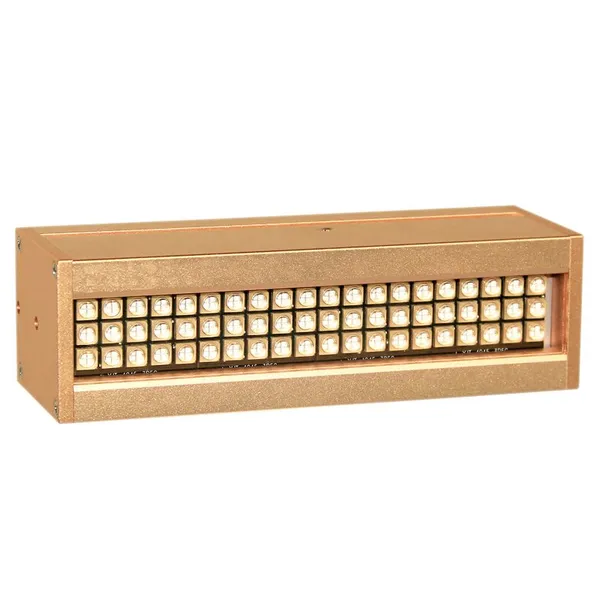
Cold-light output. Device polymers and small optical parts tolerate little thermal input, and a curing head that stays cool protects dimensions and surface finish without an added cooling stage between stations.
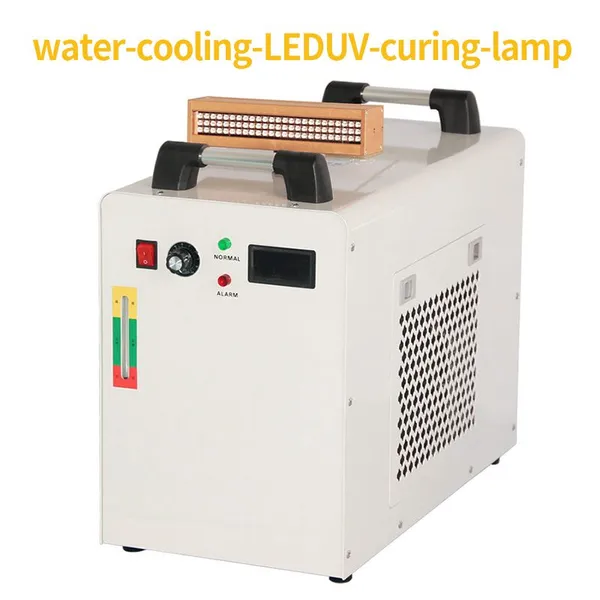
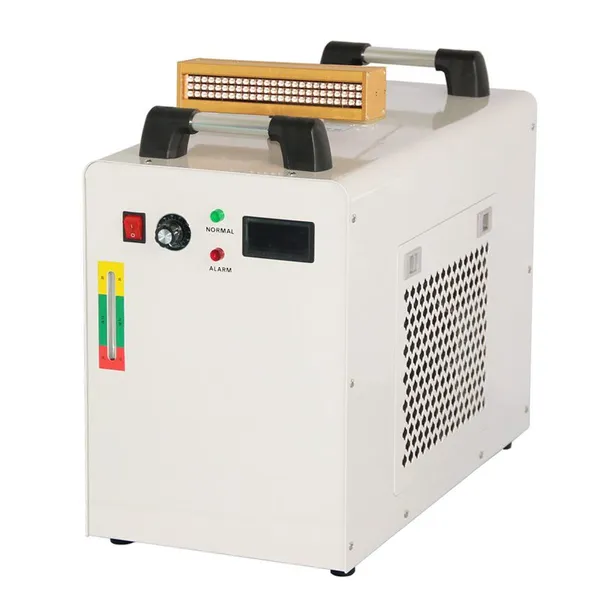
Controlled, clean cooling. A closed water circuit keeps the station independent of plant exhaust in a controlled environment and protects the emitter at continuous duty. The coolant itself has to be maintained so the system does not become a contamination source.
Stable, documented output. The irradiance reading at the production position, logged against the validated baseline, is the evidence that the process held its specification between validations. Stable output over the station's life is what makes that record meaningful.
Wavelength selection matters here as in other industries: matching the source to the adhesive's recommended band, and confirming transmission through any component the light must pass through, avoids the most common equipment-level cause of under-cure.
Risk and Economics on a Device Line
The cost structure of a device failure is different from that of a packaging line. A rejected component on a high-volume consumer product is a scrap cost. A bond failure in a device is a risk event: investigation, lot quarantine, customer notification, and a quality review that reaches the design file. The value of a validated, documented cure process is therefore not measured only in rejected parts.
The operational case for a UV LED curing lamp on device lines follows the same pattern found elsewhere: stable output, instant-on operation that fits short, frequent assembly cycles, no consumable lamp replacement interrupting a controlled process, and low energy consumption. The device-specific contribution is the cleanliness and thermal control that a controlled-environment line requires.
Most of the cost of a UV step on a device comes from validation and records, not equipment. A station chosen to support that validation — with programmable settings, logged dose, clean cooling, and documentation that names the configuration — pays back through audit readiness rather than through speed alone.
Conclusion
UV curing in medical device assembly succeeds when the light, the adhesive, the joint geometry, and the validation file are designed together. The adhesive defines what the film must be and what residuals a complete cure must eliminate. The geometry defines where light can reach and where a secondary mechanism is required. The sterilization and cleaning regime defines the durability the cured film must show. The records prove the process delivered it on every lot.
A UV LED curing lamp contributes the controllable hardware those requirements need: programmable intensity for staged cure, cold-light output that protects sensitive parts, clean closed-loop cooling for a controlled environment, and stable output that keeps the dose record meaningful across the station's life. But the lamp is the support, not the qualification. The compliant bond is the result of a validated chemistry, a designed joint, a tested sterilization path, and a traceable process — and it cannot be produced by equipment alone.
Recently Posted
-
UV Adhesive Curing in Automotive Assembly: A Structural Engineer's Guide to Bonds That Survive 15 Years on the Road
November 5, 2026Why Automotive Adhesive Bonds Fail in Places Nobody InspectsAutomotive assembly has quietly become an adhesive industry. A modern Read More
-
Finding the Real Process Window: How Top Printers Stop Guessing at UV Ink Curing
October 29, 2026Why "It Looks Dry" Is Not a Curing SpecificationWalk into any print shop and you will hear the same phrase: "the in Read More
-
UV Adhesive Curing Failures: A Process Engineer's Field Guide to Joint Strength, Shadow Zones, and Depth Cure
October 22, 2026Why UV Adhesive Projects Fail in Production — Not in the LabEvery process engineer who has specified a UV-curable adhesive has liv Read More
-
The Complete Buyer's Guide to LED UV Curing: What Every Production Manager Should Know Before Upgrading
October 15, 2026Why This Guide Matters Before You Spend a Dollar on Curing EquipmentIf you have ever stood on a production floor watching ink dry Read More

Contact Us
Recommended Products
-
 Water-Cooled UV LED Curing Light Source, 365nm / 395nm Optional, High Power Industrial UV Curing System for UV Ink, Glue, Varnish CoatingNegotiableMOQ: 1 Combo
-
CT UV LED Conveyor Curing Tunnel | Water Cooled UV Curing OvenNegotiableMOQ: 1 Combo
-
CT2 LED UV Curing Light, Industrial UV LED Dryer for Ink, Varnish & Glue CuringNegotiableMOQ: 1 Combo
-
Youjiete CT4 Industrial UV LED Curing System, UV Curing Lamp for Printing & Electronic Bonding,365nm/395nmNegotiableMOQ: 1 Combo
-
Youjiete CT5 UV LED Curing Equipment, Water Cooling UV LED Light Source for Industrial UV Adhesive and Printing Ink CuringNegotiableMOQ: 1 Combo
-
Youjiete CT10 LED Curing Machine, Industrial UV Light Source for UV Ink, Adhesive & Coating Fast CuringUS$ 5000 - 10000MOQ: 1 Combo
-
Youjiete Large‑Area UV LED Surface Light Source Curing Machine, 365nm 395nm Customizable for Industrial UV Glue, Ink & Coating CuringNegotiableMOQ: 1 Combo
-
Youjiete Industrial LED UV Curing Tunnel Furnace, Belt Conveyor UV Dryer for Offset Printing, 365nm 395nm CustomizableNegotiableMOQ: 1 Combo
-
Youjiete Desktop UV LED Curing Tunnel Furnace, Conveyor Type LED UV Curing Machine for UV Adhesive, Ink, Coating DryingNegotiableMOQ: 1 Combo
-
Youjiete Industrial Long Water‑Cooled LED UV Curing Lamp Head, UV Ink Curing LightNegotiableMOQ: 1 Combo
-
Youjiete LED UV Curing Lamp, Water‑Cooled UV LED Curing System For UV Ink, Varnish & Adhesive CuringNegotiableMOQ: 1 Combo
-
YJT‑CT4 Water‑cooled LED UV Curing Lamp 395nm Custom Size Industrial UV Ink Glue Curing LightUS$ 1520MOQ: 1 Combo
-
Power 1500w Led uv Curing LightNegotiableMOQ: 1 Combo
-
Green and Environmentally Friendly LED UV Curing MachinesUS$ 990 - 2000MOQ: 1 Combo
-
Advantages of Single Wavelength in LED UV Curing LampsUS$ 10000MOQ: 1 Combo
-
Is LED UV Harmful to Human Health?US$ 10000MOQ: 1 Combo
-
Advantages of Single Wavelength in LED UV Curing LampsUS$ 10000MOQ: 1 Combo
-
LED UV Curing LampUS$ 1980MOQ: 1 Combo
-
Green and Environmentally Friendly LED UV Curing MachinesUS$ 990 - 2000MOQ: 1 Combo
-
Green and Environmentally Friendly LED UV Curing MachinesUS$ 980MOQ: 1 Set